

If you're the parent of an autistic child, you've probably heard the word "assessment" more times than you can count, from the pediatrician, the school, the speech therapist, or the behavior analyst. Different professionals often mean slightly different things by it, which can feel confusing. This guide untangles the terminology. By the end, you'll understand the common types of assessments, their purposes, and what to expect. Processes and tools vary significantly by country, healthcare system, and cultural context, so always consult local professionals for guidance tailored to your situation.
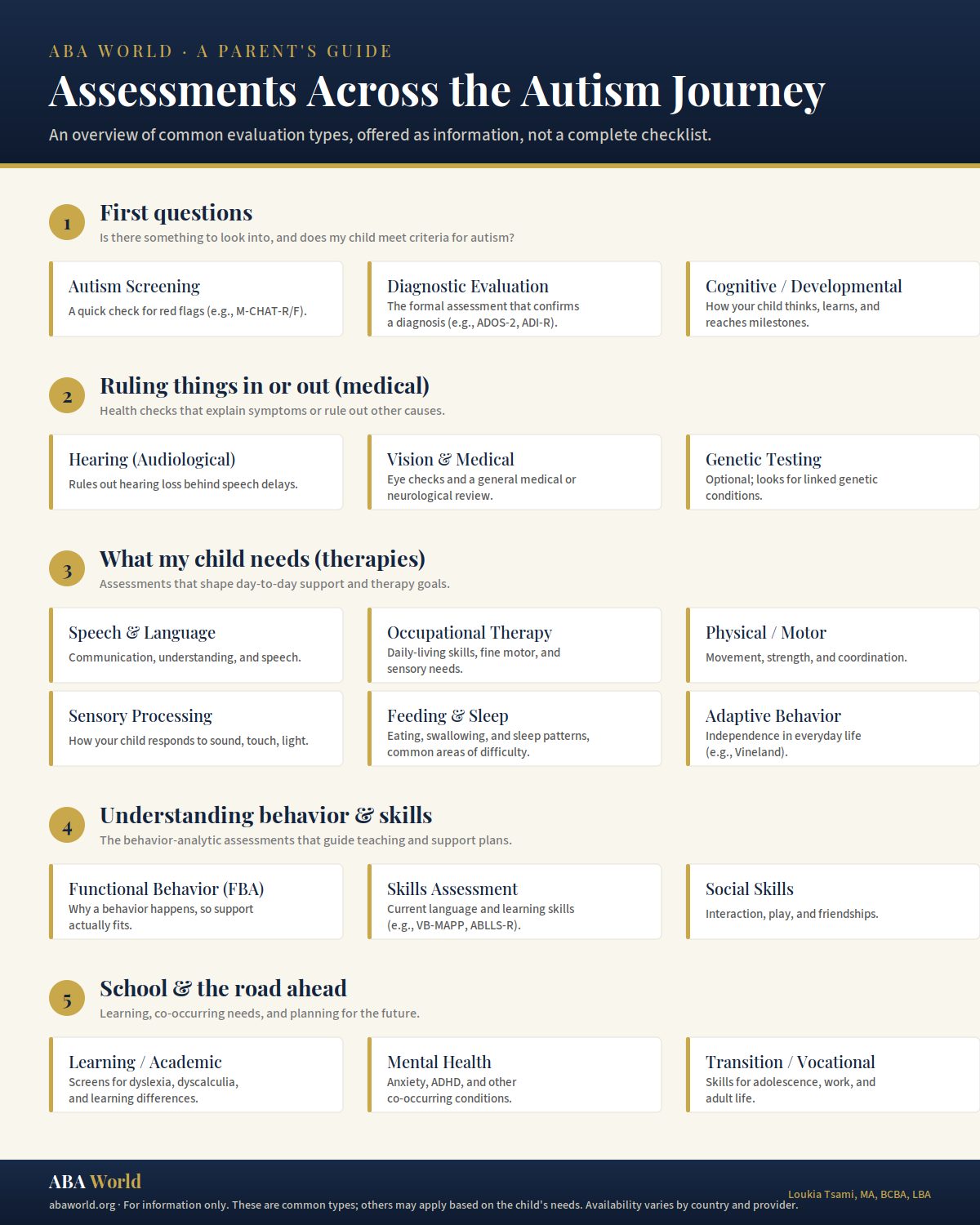
Assessment is a starting point
An assessment gathers information to inform next steps. It is rarely a one-time event. Different assessments address different questions: whether a child meets criteria for autism, what skills to target this year, or what motivates the child right now.
Early assessments
Screening is often the first step, a brief check for early signs of autism, but not a diagnosis. Pediatricians, schools, and preschools commonly use these tools, and some are designed for parents to complete at home. A widely used example is the Modified Checklist for Autism in Toddlers, Revised with Follow-Up (M-CHAT-R/F), suitable for children between 16 and 30 months. In diverse international settings, culturally adapted tools like the Nigerian Autism Screening Questionnaire (NASQ) offer promising reliability and validity, particularly in resource-limited contexts.
Diagnostic evaluation is the more comprehensive process that determines whether a child meets criteria for an autism diagnosis. It may involve one clinician or a multidisciplinary team, a developmental pediatrician, speech-language pathologist, occupational therapist, and psychologist. Duration varies from a few hours to several weeks, depending on the child's age and complexity. Older children, or those with complex needs, often require more time.
Common tools at this stage include the Autism Diagnostic Observation Schedule, Second Edition (ADOS-2), a semi-structured observation tool with modules for different ages and language levels, and the Autism Diagnostic Interview-Revised (ADI-R), a structured caregiver interview covering developmental history, communication, social interaction, and repetitive behaviors. These are frequently combined for a fuller picture. Additional elements often include a cognitive (IQ) assessment comparing learning and problem-solving to age peers, and adaptive behavior assessments such as the Vineland Adaptive Behavior Scales, which evaluate real-world daily functioning beyond a testing situation. In some cases, a genetic assessment is recommended when physical, developmental, or family-history factors suggest a possible link.
Assessments from other specialists
Autism affects multiple areas of development, so evaluations by various specialists are common. A speech-language assessment covers verbal and nonverbal communication, pragmatics, and when needed, feeding and swallowing. An occupational therapy evaluation looks at fine motor skills, daily living tasks, and sensory processing. A physical therapy assessment focuses on gross motor skills, balance, coordination, and muscle tone. Social skills assessments examine how a child interacts with peers and adults. These are often repeated every six to twelve months to track progress and update plans as the child grows.
Assessments that track progress
Once services begin, the focus shifts from diagnosis to monitoring growth. Skill-based assessments such as the ABLLS-R or VB-MAPP map a child's current language, learning, and social skills to set goals, typically revisited every six to twelve months. Preference assessments identify what truly motivates the child so therapy stays engaging. Environmental assessments examine how the child interacts with their surroundings. Some tools are standardized (comparing the child to same-age peers); others are ipsative (comparing the child only to their own past performance). It's always helpful to ask your provider which type is being used.
Once school starts
Entering school often introduces new assessments, some unrelated to autism specifically. If a child struggles with reading or math, learning assessments may check for differences such as dyslexia or dyscalculia. When challenging behaviors like aggression, tantrums, or self-injury occur, a Functional Behavior Assessment (FBA) can identify the reasons behind the behavior, so interventions address the root cause rather than just the symptoms.
Assessments for older learners
As children grow, assessments increasingly focus on independence and future planning. Prevocational assessments evaluate foundational work-readiness skills such as following instructions and task persistence, generally introduced in the teenage years. Vocational assessments then explore specific job skills and interests to guide employment or training, often as part of transition planning toward adulthood.
The key takeaway
The word "assessment" means different things to different professionals. Teachers track academic progress, pediatricians monitor developmental milestones, and therapists evaluate their specific domains. Ongoing assessment is a positive sign that the team is paying close attention, staying curious, and adjusting support to meet your child's evolving needs. If it feels repetitive, it usually means a new question is being addressed that matters at the current stage.
You know your child best, so please ask questions such as: "What are we hoping to learn, and how will this help my child?" Tools and practices differ internationally, and cultural adaptations like the NASQ highlight the value of context-appropriate approaches.
Common assessments at a glance
As the list below shows, there are many kinds of assessment, which is exactly why the terminology can feel confusing. Seeing them together often helps parents realize the confusion is normal.
This table is illustrative, not exhaustive. Clinical teams select the right tools based on individual needs.
| Assessment | Purpose | Typical Age | Frequency |
|---|---|---|---|
| M-CHAT-R/F | Autism screening | 16-30 months | Once; repeat if concerns |
| NASQ | Culturally adapted autism screening | Community use (e.g. Nigeria) | As appropriate locally |
| ADOS-2 | Diagnostic observation | 12 months+ (module by level) | As needed for diagnosis/follow-up |
| ADI-R | Diagnostic caregiver interview | 18 months+ | Part of diagnostic process |
| CARS | Severity rating | 2 years+ | As needed |
| Cognitive / IQ Assessment | Learning & problem-solving vs. peers | 2 years+ | Typically once at diagnosis; as needed |
| Genetic Assessment | Identify associated conditions | Any age | Typically once |
| Speech-Language Assessment | Communication, pragmatics, feeding | Any age | Every 6-12 months |
| OT Evaluation | Fine motor, daily living, sensory | Any age | Every 6-12 months |
| PT Assessment | Gross motor, coordination | Any age | Every 6-12 months |
| Social Skills Assessment | Peer / adult interactions | Any age | Every 6-12 months |
| ABLLS-R | Language & learning skills | Broad (adaptable) | Annually or biannually |
| VB-MAPP | Verbal / social milestones | Broad | Every 6-12 months |
| Vineland Adaptive Behavior Scales | Daily living / adaptive skills | Birth to adulthood | Every few years / as needed |
| Preference Assessments | Identify motivators | All ages | Ongoing |
| FBA | Function of problem behavior | School age+ | As needed |
| Prevocational / Vocational | Work readiness / job matching | Teens+ | Part of transition planning |
References
Bakare, M. O., Frazier, T. W., Karpur, A., Abubakar, A., Nyongesa, M. K., Mwangi, P. M., et al. (2022). Brief report: Validity and reliability of the Nigerian Autism Screening Questionnaire. Autism, 26(6), 1581–1590.
Lord, C., Rutter, M., DiLavore, P. C., Risi, S., Gotham, K., & Bishop, S. (2012). Autism Diagnostic Observation Schedule, Second Edition (ADOS-2). Western Psychological Services.
Partington, J. W. (2010). The Assessment of Basic Language and Learning Skills-Revised (ABLLS-R). Behavior Analysts, Inc.
Robins, D. L., Fein, D., & Barton, M. (2009). Modified Checklist for Autism in Toddlers, Revised with Follow-Up (M-CHAT-R/F).
Sparrow, S. S., Cicchetti, D. V., & Saulnier, C. A. (2016). Vineland Adaptive Behavior Scales, Third Edition. Pearson.